
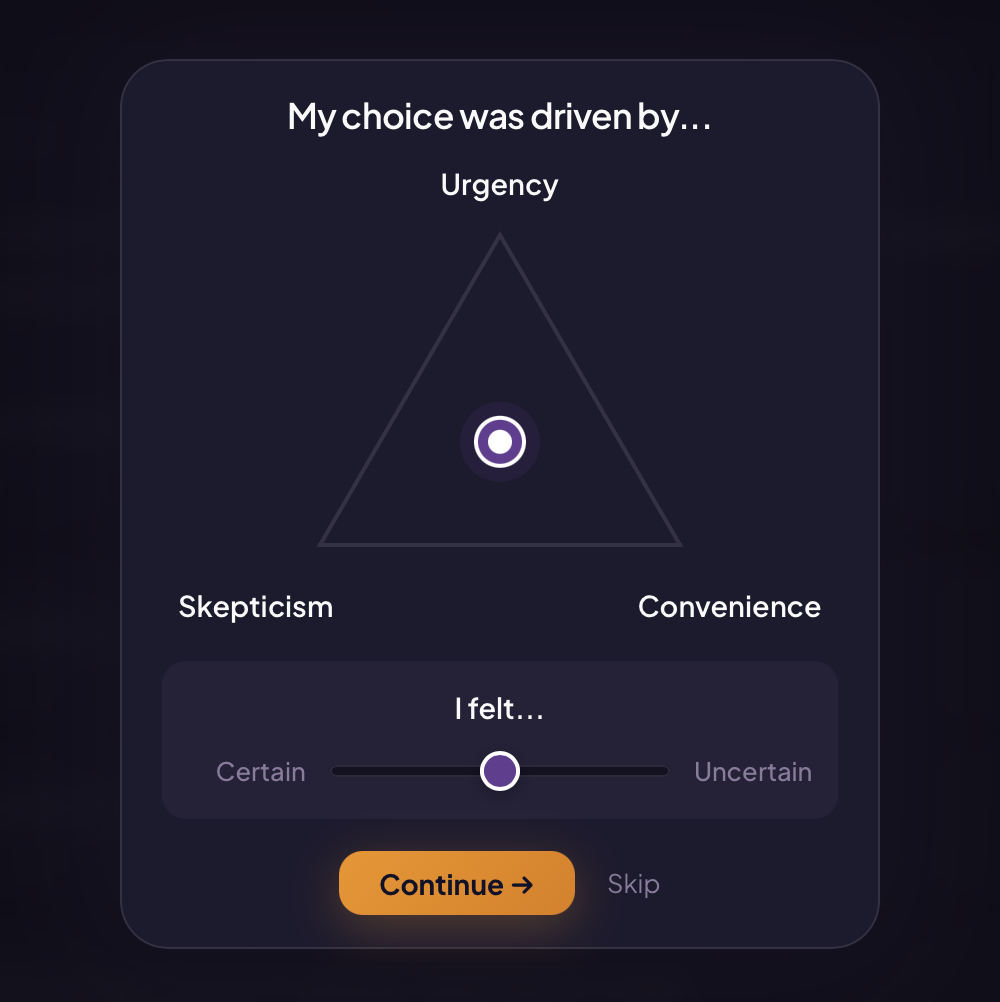
Most training platforms can tell you what someone clicked. Some can even ask a follow-up: “Why did you choose that?”
But if you’ve ever reviewed those responses, you know the problem: free-text explanations are rich, and hard to use. They’re inconsistent, time-consuming to interpret, and almost impossible to compare across teams. You end up with a pile of “reasons” and no clear way to see patterns, spot risk, or improve the training itself.
That’s why PathBind treats signification differently.
In PathBind, signification isn’t just a reflective moment. It’s a way to turn judgment into structured signals you can aggregate, compare, and, crucially, connect to outcomes.
Reasoning Visibility Is Helpful. But It’s Not Enough.
“Reasoning visibility” sounds great: learners explain their thinking, and you gain insight into how decisions are made.
The catch is that most “reasoning visibility” stops at the anecdote level:
- One learner says “I wasn’t sure.”
- Another says “This felt faster.”
- A third says “That’s what we usually do.”
You might learn something in individual cases. But it’s hard to answer bigger questions like:
Does this cohort prioritize speed over caution?*
Are people confidently wrong in the same places?*
Is the scenario unclear, or are people just split in their judgment?*
PathBind’s signification is designed specifically to answer those questions.
1) Triads: A Measurable Tradeoff, Not a Narrative
When PathBind asks “why,” it doesn’t require a paragraph. Instead, it uses a triad: a choice among three competing values (for example: speed vs caution vs principle).
Learners indicate where they fall within that triangle.
This matters because it turns “why” into a consistent shape you can compare across people and sessions. Instead of hundreds of different phrases, you get a map of judgment.
What that unlocks:
- Population patterns
You can see tendencies across groups:
“This cohort consistently leans toward speed over caution.”
That’s not a guess. It’s an observable pattern.
- Spread and disagreement
If responses are scattered, it’s a signal. Sometimes it means your learners truly have different instincts. Other times it means the scenario is framed ambiguously and people are reading it in incompatible ways. Either way, you’ve learned something actionable.
In other words, triads don’t just collect “reflection.” They reveal how a group thinks.
2) Dyads: Confidence as a Signal (Not a Vibe)
PathBind also asks learners to place their confidence on a dyad, a simple spectrum from low to high.
That sounds small, but it’s powerful for one reason: it’s measurable.
Because confidence is captured as a continuous value, PathBind can distinguish between:
- Stable confidence (someone is consistently sure)
- Inconsistent confidence (someone swings between extremes)
- Confidence shifts over time (someone becomes more certain as they learn, or more cautious as they realize the complexity)
Most training analytics treat confidence as either absent or informal. PathBind treats it as a real behavioral signal.
3) The “Beyond Reasoning” Moment: Confidence Linked to Correctness
Here’s the breakthrough that makes signification more than a “nice reflection feature”:
PathBind is built so confidence can be reliably linked to what actually happened next, whether the learner was correct, incorrect, or needed assistance to continue.
That enables a different class of insight:
- Overconfidence: high confidence + wrong outcome
- Underconfidence: low confidence + correct outcome
- Calibration: how well confidence matches performance over time
And because PathBind can analyze this by scenario and concept, it can surface things like:
- Overconfidence hotspots
“People are highly confident and consistently wrong at this decision point.”
That’s a risk signal, not just a learning signal.
- Coaching and remediation targets
You’re not just reteaching content. You’re addressing judgment errors and false certainty where it matters.
This is where signification becomes operational: it turns reflection into a form of measurable evidence that decision-makers can act on.
4) It Feeds Adaptation, Not Just Reporting
In many systems, reflection is a dead end: learners reflect, the system stores it, and nothing changes.
PathBind goes further. Confidence mismatch can contribute to the learner’s “debt” profile, alongside other performance signals. That debt profile influences when the experience offers more support, more synthesis, or more scaffolding.
So signification isn’t just something you analyze afterward.
It changes what the learner experiences next.
What This Means for PathBind’s Place in the Market
This is why PathBind isn’t just “another branching scenario tool.”
Traditional branching tools are excellent at building interactive paths, but they typically measure progress in familiar ways: completion, quiz scores, maybe a few clicks and timers.
PathBind pairs scenario delivery with diagnostic signals:
- tradeoffs learners consistently make
- confidence patterns
- calibration (confidence vs performance)
- risk concentrations by node or concept
That matters for teams who aren’t simply trying to “deliver training,” but trying to reduce mistakes in real environments, especially where audits, compliance outcomes, or safety incidents are on the line.
The Bottom Line
Reasoning visibility tells you what someone says they were thinking.
Signification tells you how they tend to decide, and whether their certainty matches reality.
That’s the difference between training that’s merely interactive and training that produces usable insight about judgment.