Most training platforms can tell you what choice a learner made.
They cannot tell you why.
This limitation is not cosmetic. It is structural. Traditional e-learning systems record outcomes but remain blind to the thought processes that produce those outcomes. A correct answer achieved through careful reasoning looks identical to a correct answer achieved by guessing. A wrong answer driven by a consistent heuristic looks the same as one driven by confusion.
Self-signification was developed to close this gap.
In consequence-driven learning systems like PathBind, self-signification functions as the missing layer between a learner’s decision and their actual reasoning. It transforms invisible mental processes into observable, analyzable evidence.
The problem with outcome-only learning data
Standard e-learning platforms are built around outcome tracking. They log clicks, scores, completion rates, and time spent. These metrics are easy to aggregate and easy to report.
What they do not capture is intent.
When analysis stops at the final answer, several critical distinctions disappear:
- whether a learner reasoned correctly or guessed correctly
- whether a wrong decision came from overconfidence or uncertainty
- whether errors reflect a stable pattern or random noise
As a result, organizations are left with training data that looks reassuring but explains very little about real-world behavior.
This is one reason employees can pass training yet continue to make costly mistakes on the job.
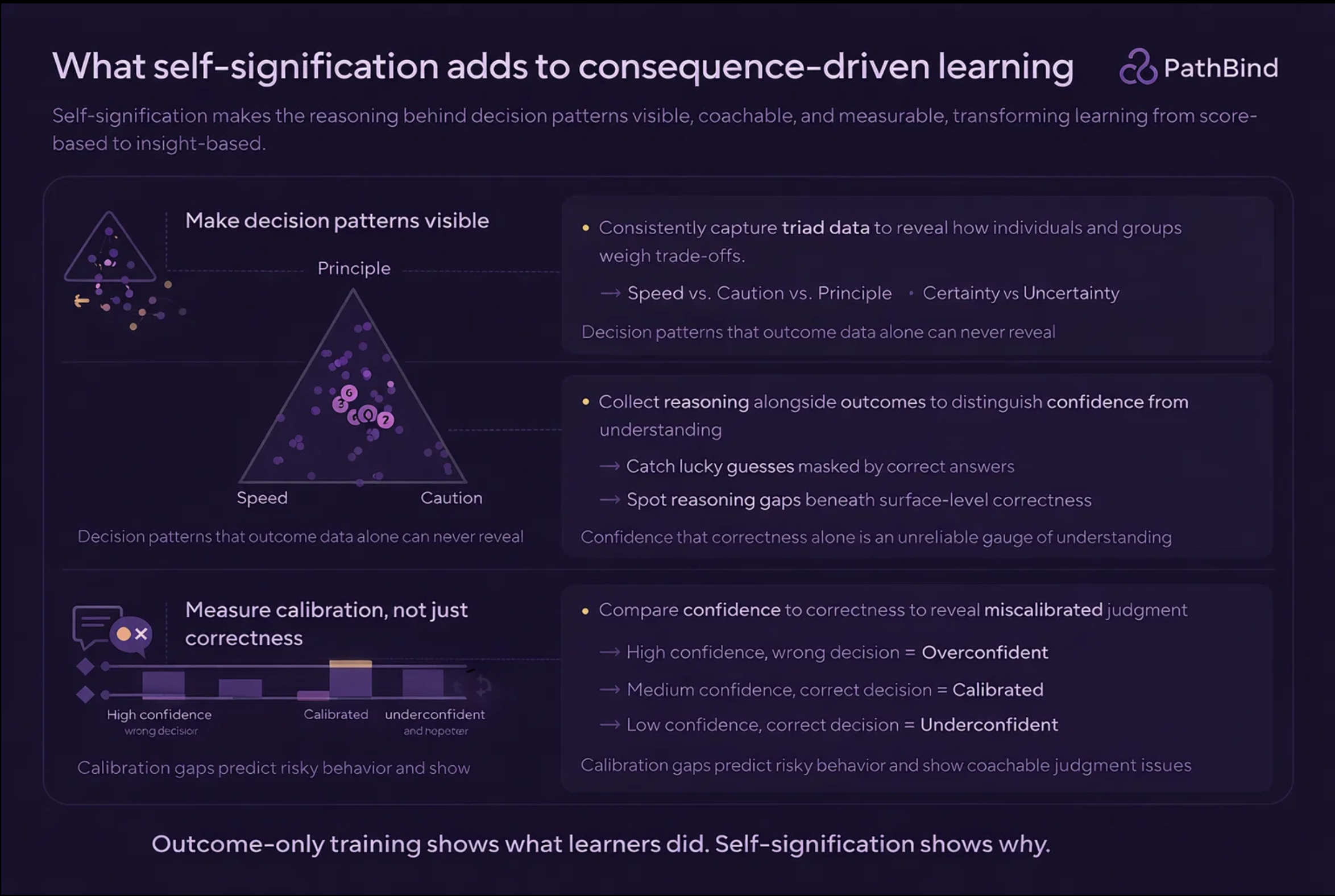
What self-signification adds to consequence-driven learning
Self-signification introduces a structured reflective layer immediately after meaningful decisions.
Instead of asking learners to write open-ended explanations, PathBind uses two lightweight cognitive instruments:
- a triad that captures which competing values or heuristics influenced the decision
- a dyad that captures how confident the learner felt
These inputs are fast to complete and cognitively precise. They do not interrupt the learning flow, but they dramatically increase what the system can observe.
Crucially, self-signification is collected at the moment when reasoning matters most. It is prompted immediately after a negative or incorrect decision, when the learner’s internal model has just failed and their assumptions are exposed.
Making invisible decision patterns visible
When learners consistently self-signify their reasoning, patterns emerge that outcome data alone can never reveal.
Some learners show a tendency toward speed and efficiency, even when risk is high.
Others consistently prioritize caution and avoidance.
Some rely on principle and policy even under pressure.
Others reveal uncertainty masked by confident clicking.
These patterns are not inferred. They are directly reported by the learner at the moment of decision.
Over time, this creates a profile of how individuals and groups approach trade-offs, ambiguity, and risk.
Separating logic from luck
Traditional quizzes treat correct answers as proof of understanding.
In reality, correctness alone is ambiguous. A lucky guess and a well-reasoned decision look identical in standard training data.
Self-signification breaks this equivalence.
When a learner explains why they chose an option, instructors and systems can evaluate whether the reasoning aligns with the intended concepts. Correct answers supported by weak or incoherent reasoning are no longer indistinguishable from genuine understanding.
This distinction matters because luck does not transfer to real work. Reasoning does.
Turning reasoning into a coachable signal
Because self-signification makes reasoning explicit, it allows coaching to focus on judgment rather than repetition.
Instead of assigning more content indiscriminately, leaders can identify specific reasoning gaps such as:
- misjudging risk severity
- prioritizing speed over accuracy
- misunderstanding escalation thresholds
- applying rules mechanically without context
This enables targeted intervention before mistakes occur in real environments. Training becomes preventative rather than corrective.
From reflection to analytics
In PathBind, self-signification is not treated as commentary. It is treated as evidence.
Each self-signification event is recorded alongside the decision it reflects and aggregated across sessions. This allows the platform to generate:
- triad point clouds that show dominant heuristics and value trade-offs
- dyad distributions that reveal confidence patterns
- comparative views across individuals, teams, and scenarios
These analytics make reasoning patterns visible at scale, without relying on anecdote or intuition.
Measuring calibration, not just correctness
One of the most important insights enabled by self-signification is calibration.
When confidence data from the dyad is compared against decision correctness, the system can identify systematic miscalibration. High confidence paired with incorrect decisions indicates overconfidence. Low confidence paired with correct decisions indicates underconfidence.
This gap between confidence and accuracy is recorded as calibration debt. Instead of treating misjudgment as a one-off error, PathBind makes it measurable as a recurring pattern.
Calibration is a known predictor of risk in high-stakes environments. Making it visible transforms it from an abstract concern into a trainable signal.
Self-signification as a cognitive map
A final answer tells a system where the learner ended up.
Self-signification explains how they got there.
It functions as a narrative map of decision making, capturing values, trade-offs, and certainty at the moment choices are made. When combined with consequence-driven scenarios, this map allows training systems to reflect how people actually think under realistic conditions.
That reflection is what allows learning platforms to move beyond completion metrics and toward genuine capability development.
Why this matters for modern training
Organizations are no longer satisfied with knowing that training occurred. They need evidence that training builds judgment, reduces risk, and prepares people for real decisions.
Outcome-only training cannot provide that evidence.
Self-signification can.
By binding outcomes to intent, PathBind transforms training from a record of answers into a record of thinking. And thinking is what determines behavior when there is no quiz screen guiding the next click.